Code 95 guidelines explained
For some of our training courses, DELTA Safety Training has recently been permitted to allocate training hours for Code 95 competence to participants. We have noticed that both participants and HR departments have many questions about the Code 95 guidelines. It is not clear to everyone what Code 95 exactly entails and in which situations you must comply with the Code 95 standard. Therefore, we explain in this article what Code 95 means, in which situations you are obliged to follow/pass the hours of professional competence from this guideline, and what the extra requirements are that are imposed on DELTA Safety Training's courses.
What is Code 95 and who does it apply to?
Code 95 is an indication on the driving licence that shows that a driver is competent. All European bus and lorry drivers (exceptions explained later in this article) who transport people and/or goods and are therefore in possession of a C1(E), C(E), D1(E) or D(E) driving licence, are obliged to have a Code 95 qualification (code95.nl). You can obtain this basic qualification by taking both theoretical and practical exams. The number of exams you have to take depends on the number of driving licences you already have (cbr.nl).
If the D (bus) driving licence without Code 95 was issued after the 10th of September 2008, the basic qualification for passenger transport must be met in order to obtain the Code 95 designation. 35 hours of refresher training must be followed to renew it. The same applies to the C (truck) driving licence issued after the 10th of September 2009 without Code 95. Professional drivers who obtained their driving licence before this period only have to fulfil the periodic training obligation (35 hours).

Exceptions to the Code 95 obligation
Code 95 replaces the former drivers' certificate and was introduced to increase road safety within Europe and reduce the number of accidents involving buses and lorries. Code 95 was made compulsory by the European Directive on Professional Competence. This Directive lays down all the agreements and obligations that must be met in order to be and remain a professional driver. This Directive applies to all professional drivers who come from the EU and/or professional drivers who work within the EU (code95.nl). If drivers do not comply with this directive, they risk a high fine. Some groups of professional drivers are exempted from the compulsory training hours. These include fire brigade drivers, police officers and drivers of circus and fairground vehicles. For all exemptions, you can check the full list of exemptions.
Point count
Code 95 points are valid for a periode of five years. This means that a professional driver has five years to complete his or her 35 hours of training. These training hours are obtained according to a point counting system. For example, the 35 hours of training are equal to 35 points.
Below you can find a summary of some of the rules regarding the points system:
- A trainee is obliged to obtain 35 points in five years
- Per course day, the trainee is awarded seven points
- One course may be repeated, the rest must be identical (effective from July 1, 2021)
- A course that counts for more than seven points may not be repeated
- If more than 35 points are obtained, these extra points will fall due
- From 1 July 2021, there is a limit to how many times a CVT course may be repeated within one CVT cycle. Until July 1, 2021 this could be arranged freely
- From July 1, 2021 a maximum of 12 of the 35 training hours may consist of e-learning. A training course by e-learning is worth four hours, which means that you can take a maximum of three courses in five years.
Do you want to know which other regulations apply or which guidelines apply to your situation? Then let the Centraal Bureau Rijvaardigheidsbewijzen (CBR) advise you.

Courses in which Code 95 points are issued
Within our training center, points are issued for a number of training courses that contribute to the Code 95 point count. Below is an overview of these training courses and the corresponding points:
- Heftruck - Herhaling (7 points)
- VCA - Herhaling (7 points)
- EHBO - Basis - (7 points)
- EHBO - Herhaling (7 points)
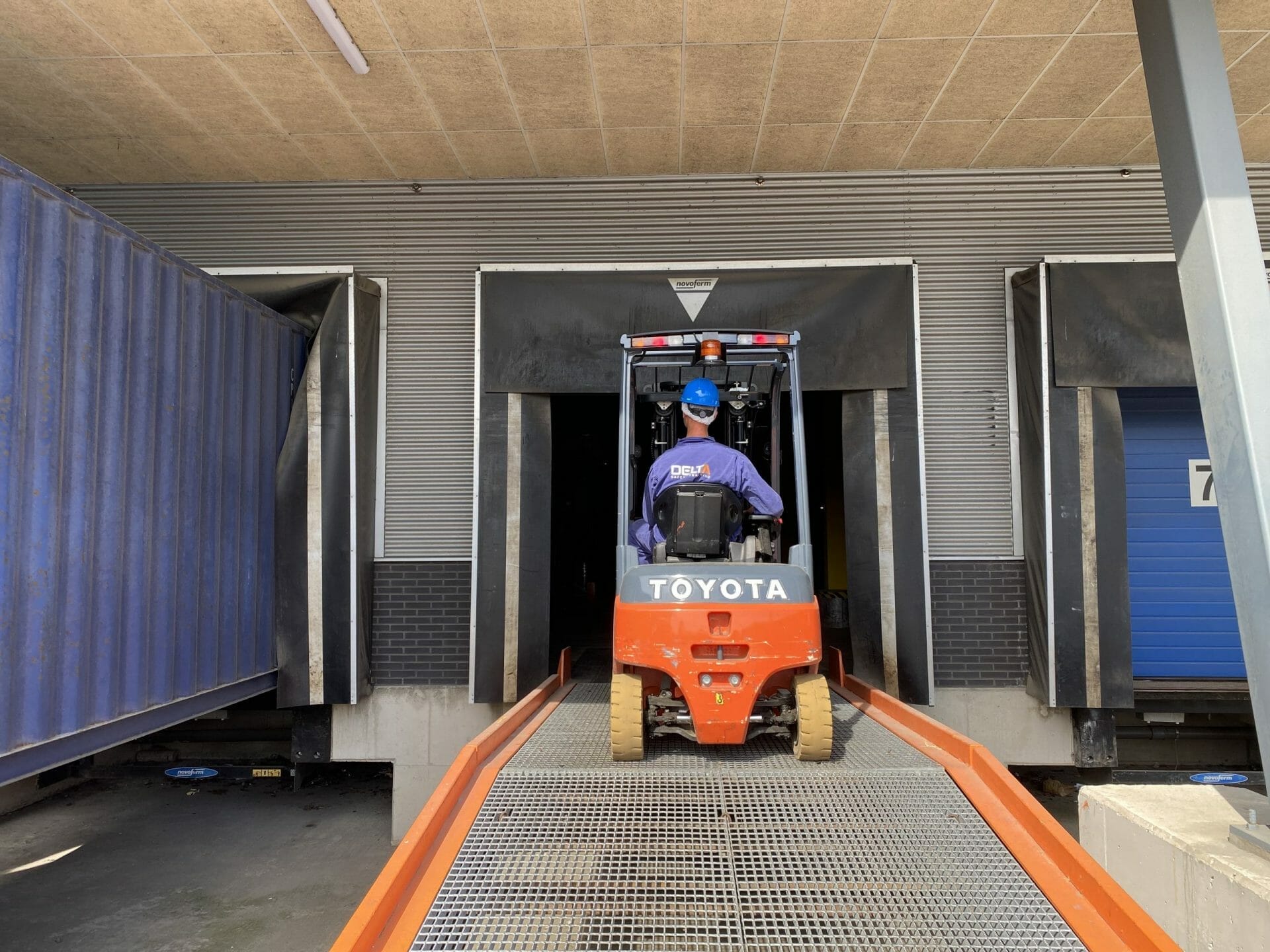
The forklift training that is given according to the Code 95 training plan differs slightly from our regular forklift training. Our regular training is mainly aimed at being able to work safely in a warehouse. The forklift training which is given according to the Ccode 95 training plan is mainly aimed at loading and unloading a truck. According to the guidelines of the CBR, it is not necessary to take an exam. However, we do offer an exam. So, participants can both receive Code 95 points and a certificate after completing the training.
Requirements for a trainer
To be able to offer training courses that issue the Code 95 points, you have to follow a strict protocol as a trainer. First of all, as a trainer you must submit a training plan to the CBR. When this plan is approved, as a training center you are obliged to follow all steps in this training plan carefully. In addition, a number of strict procedures have to be followed. At the training day, all attendees are required to identify themselves. Any changes must be reported in the CBR portal no later than 30 minutes after the start of the training. When a student leaves a training course prematurely, this should also be reported immediately to the portal. By doing this, the CBR always has the correct information available in case of a random check.
Would you like to know more about our training courses that issue Code 95 points? Our colleagues will be happy to explain it to you!