• The specialist in safety training for more than 25 years
  • Rated 4.5/5 stars on average!
  • NRTO accredited
STEP budget!

UPDATE: STAP budget is coming to an end!

UPDATE: STAP budget is coming to an end!

General FIRST AID/EMERGENCY MEDICAL CARE Industry Offshore Shipping VCA Wind
July 12, 2023

On June 6, 2023, the Ministers of Social Affairs and the Minister of Education announced the decision that the STAP scheme will be tightened from then on. This means that a smaller budget will be made available for the STAP subsidy for the rest of 2023. Only OCW-recognized programs will have an eligible educational offer from now on. This means that as of June 6, 2023, you can no longer apply for a STAP subsidy for a safety training course booked with DELTA Safety Training. We will of course be happy to continue to provide safety training for you with the quality you have come to expect from us! Stay safe!

----------------------------------------------------

STAP budget: 1000 euros training budget for everyone every year

Your own training budget of 1,000 euros (incl. VAT) per year. All for nothing. Since 1 March 2022, this is available to (almost) everyone who is allowed to work in the Netherlands. The STAP budget is a new national government subsidy that you can easily apply for yourself, without involving your employer, to follow an education, course or training. DELTA Safety Training is a recognised training institute where you can spend the STAP budget. The costs of extra training will therefore no longer be an obstacle for anyone.

STAP stands for STimulering ArbeidsmarktPositie (stimulation of labour market position). This new government regulation makes it easier for everyone to follow an education, course or training that contributes to improving their position on the labour market. The STAP budget replaces the deduction of study costs via the income tax. For many people, this kind of allowance for training costs proved to be a bridge too far.

Take control of your own career

With the STAP budget, the government gives employees and jobseekers more control over their own careers. A specific training course can be very important for keeping your job or taking the next step in your career. Financial thresholds should not be a reason to forego this. The STAP arrangement prevents this and makes (additional) training feasible for everyone.

Total available

In 2022, around EUR 160 million will be available, which means for at least 160,000 people. In 2023, this budget will rise to EUR 200 million.

Use STEP budget very easily

The government has made applying for a STAP budget as easy as possible. If you wish to follow one of the many available safety training courses at DELTA Safety Training with your STAP budget, then you only need to do a few things as a prospective course participant. Please note: you must apply for the STAP budget yourself via DigiD. Your employer or we as training provider cannot do that for you. Applying works as follows:

  • Register via our website for the specific training you have in mind and indicate in the comments field that you want to use your STAP budget;
  • We will confirm your registration and send you a digital STAP registration certificate;
  • Then log on to the UWV STAP portal. Here you apply for your STAP budget for the selected training course. You must also upload the STAP registration certificate you received from us;
  • After four weeks, the UVW will let you know whether the application has been approved;
  • If so, the UWV pays the requested STAP budget directly to us. As an applicant, you do not have to worry about this yourself. You can start the training on the planned date.
  • Finally, we also ensure that after the training, the UWV receives proof of your participation.

For training courses that cost less than 1000 euro (including VAT) - as is often the case with DELTA Safety Training - you pay nothing yourself. Exceptions are extra textbooks or study material. If the training is more expensive than 1000 euro, then you only pay the difference yourself. Once a year, everyone can apply to the UWV for training from the STAP budget. This means that if you apply for a training course of 500 euros including VAT in one year, you cannot apply again in that year for another training course of, for example, 400 or 500 euros.

Note! The UWV divides the government funds available for the STAP budget through the year into six 2-month periods. Every 2 months a new application period STAP budget starts. Have you run out of budget now? Then try again in a subsequent application period. The next opportunity you can apply for STAP budget is Monday, September 4, 2023 starting at 10:00 am.

2022:

  • 1 March 2022 to 1 May 2022 (closed, no more grants available)
  • 2 May 2022 to 30 June 2022 (closed, no more grants available)
  • 1 July 2022 to 31 August 2022 (closed, no more grant available)
  • September 1, 2022 through October 31, 2022 (closed, no more grant available)
  • November 1, 2022 to December 31, 2022 (closed, no more grant available)

2023:

  • Application period January 2023 expires!
  • Feb. 28, 2023 March 17, 2023 to April 30, 2023 (closed, no more grants available)
  • May 1, 2023 to July 2, 2023 (closed, no more grant available)
  • July 3, 2023 to September 3, 2023 (closed, no more grant available)
  • Sept. 4, 2023 to Oct. 31, 2023 (training start date may be no later than Jan. 31, 2024)
  • November 1, 2023 to December 31, 2023 (training start date may be no later than March 31, 2024)


During the first rounds, the budget was fully used within a few hours and even breakdowns occurred. So be quick on September 4. Run out is run out! Also read more about the situation during the first round on the UWV site here.

An important note is that a training can start no earlier than one month and no later than 3 months after the end date of the application period. Thus, if you apply for the grant on Aug. 15, the training should start no later than Nov. 31, 2023.


DELTA Safety Training recognised training institute

The use of the STAP budget is also subject to a few conditions. Training courses must always be aimed at strengthening your position on the labour market. To put it bluntly: a course in hobby flower arranging for someone who works in the petrochemical industry is not part of this. Moreover, the training must take place at a recognised training institute, such as DELTA Safety Training. Virtually all safety training courses we offer are eligible for use of the STAP budget. Make your choice quickly.

More details about the conditions for using the STAP budget can be found on the STAP portal of the UWV.
Code 95 forklift training loading dock

Code 95 guidelines explained

Code 95 guidelines explained

General OCCUPATIONAL HEALTH AND SAFETY DELTA Industry SOG VCA
26 August 2021

For some of our training courses, DELTA Safety Training has recently been permitted to allocate training hours for Code 95 competence to participants. We have noticed that both participants and HR departments have many questions about the Code 95 guidelines. It is not clear to everyone what Code 95 exactly entails and in which situations you must comply with the Code 95 standard. Therefore, we explain in this article what Code 95 means, in which situations you are obliged to follow/pass the hours of professional competence from this guideline, and what the extra requirements are that are imposed on DELTA Safety Training's courses.

What is Code 95 and who does it apply to?

Code 95 is an indication on the driving licence that shows that a driver is competent. All European bus and lorry drivers (exceptions explained later in this article) who transport people and/or goods and are therefore in possession of a C1(E), C(E), D1(E) or D(E) driving licence, are obliged to have a Code 95 qualification (code95.nl). You can obtain this basic qualification by taking both theoretical and practical exams. The number of exams you have to take depends on the number of driving licences you already have (cbr.nl).
If the D (bus) driving licence without Code 95 was issued after the 10th of September 2008, the basic qualification for passenger transport must be met in order to obtain the Code 95 designation. 35 hours of refresher training must be followed to renew it. The same applies to the C (truck) driving licence issued after the 10th of September 2009 without Code 95. Professional drivers who obtained their driving licence before this period only have to fulfil the periodic training obligation (35 hours).

Forklift Truck Code-95 Training

Exceptions to the Code 95 obligation


Code 95 replaces the former drivers' certificate and was introduced to increase road safety within Europe and reduce the number of accidents involving buses and lorries. Code 95 was made compulsory by the European Directive on Professional Competence. This Directive lays down all the agreements and obligations that must be met in order to be and remain a professional driver. This Directive applies to all professional drivers who come from the EU and/or professional drivers who work within the EU (code95.nl). If drivers do not comply with this directive, they risk a high fine. Some groups of professional drivers are exempted from the compulsory training hours. These include fire brigade drivers, police officers and drivers of circus and fairground vehicles. For all exemptions, you can check the full list of exemptions.

Point count

Code 95 points are valid for a periode of five years. This means that a professional driver has five years to complete his or her 35 hours of training. These training hours are obtained according to a point counting system. For example, the 35 hours of training are equal to 35 points.

Below you can find a summary of some of the rules regarding the points system:
- A trainee is obliged to obtain 35 points in five years
- Per course day, the trainee is awarded seven points
- One course may be repeated, the rest must be identical (effective from July 1, 2021)
- A course that counts for more than seven points may not be repeated
- If more than 35 points are obtained, these extra points will fall due
- From 1 July 2021, there is a limit to how many times a CVT course may be repeated within one CVT cycle. Until July 1, 2021 this could be arranged freely
- From July 1, 2021 a maximum of 12 of the 35 training hours may consist of e-learning. A training course by e-learning is worth four hours, which means that you can take a maximum of three courses in five years.

Do you want to know which other regulations apply or which guidelines apply to your situation? Then let the Centraal Bureau Rijvaardigheidsbewijzen (CBR) advise you.

Forklift code 95 training

Courses in which Code 95 points are issued


Within our training center, points are issued for a number of training courses that contribute to the Code 95 point count. Below is an overview of these training courses and the corresponding points:
- Heftruck - Herhaling (7 points)
- VCA - Herhaling (7 points)
- EHBO - Basis - (7 points)
- EHBO - Herhaling (7 points)

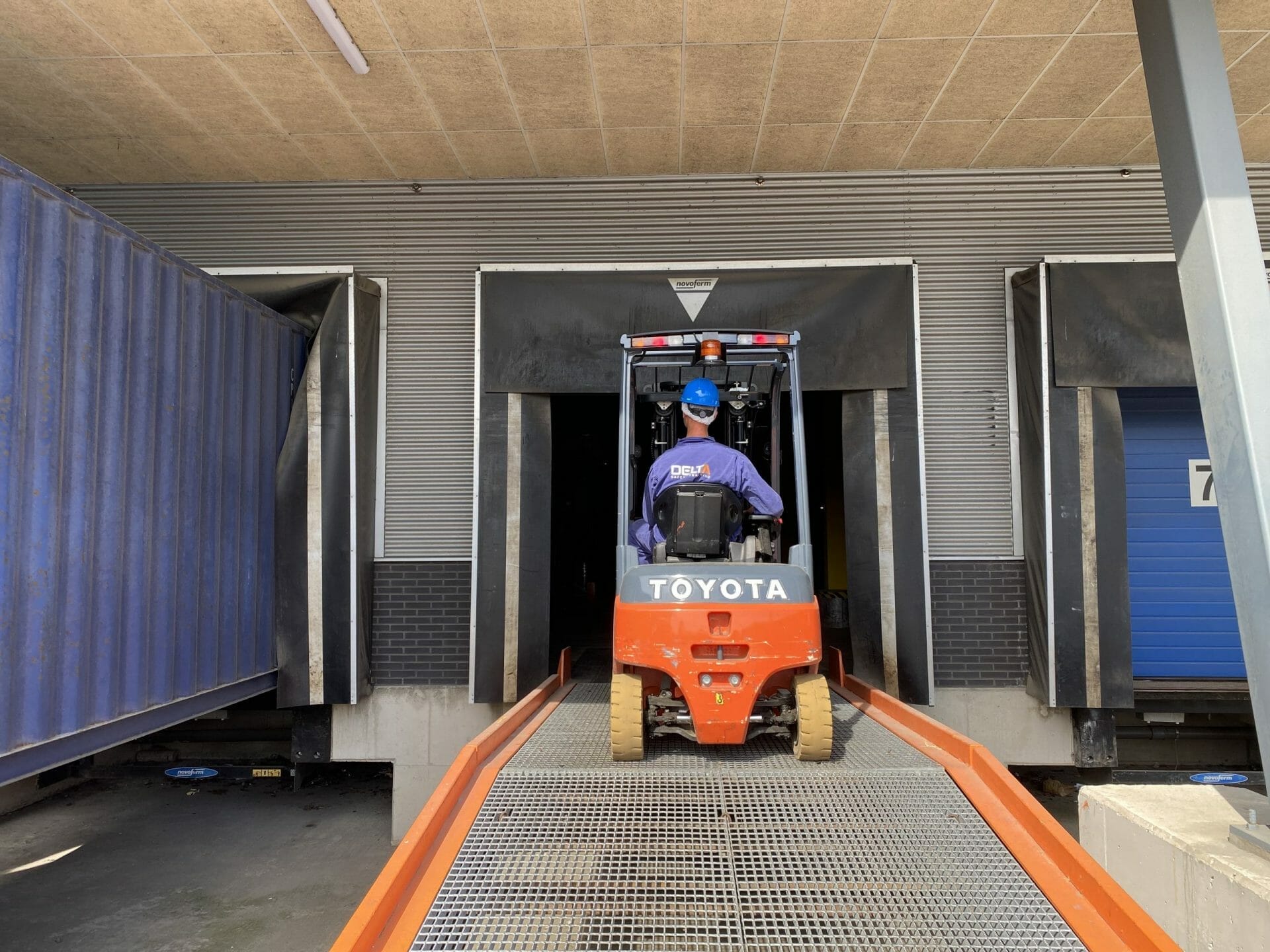
The forklift training that is given according to the Code 95 training plan differs slightly from our regular forklift training. Our regular training is mainly aimed at being able to work safely in a warehouse. The forklift training which is given according to the Ccode 95 training plan is mainly aimed at loading and unloading a truck. According to the guidelines of the CBR, it is not necessary to take an exam. However, we do offer an exam. So, participants can both receive Code 95 points and a certificate after completing the training.

Requirements for a trainer

To be able to offer training courses that issue the Code 95 points, you have to follow a strict protocol as a trainer. First of all, as a trainer you must submit a training plan to the CBR. When this plan is approved, as a training center you are obliged to follow all steps in this training plan carefully. In addition, a number of strict procedures have to be followed. At the training day, all attendees are required to identify themselves. Any changes must be reported in the CBR portal no later than 30 minutes after the start of the training. When a student leaves a training course prematurely, this should also be reported immediately to the portal. By doing this, the CBR always has the correct information available in case of a random check.

Would you like to know more about our training courses that issue Code 95 points? Our colleagues will be happy to explain it to you!

Contact form

  • This field is for validation purposes and should not be changed.

Rescue from a wind turbine

Demonstration of evacuation and rescue from a wind turbine (vlog)

Demonstration of evacuation and rescue from a wind turbine (vlog)

General GWO Offshore OPITO Wind
31 May 2021

DELTA Safety Training is a dynamic company with a lot going on. Through a series of vlogs, we would like to give you an impression of how things work at our company. Today, Rolf gives a short demonstration.

Rolf has been a trainer at DELTA Safety Training for four years now. His focus is on wind (GWO), offshore oil and gas (OPITO, NOGEPA) and particularly working at height training. In a clear demonstration, he shows two critical parts of the training 'Working at height'.

Evacuation from the wind turbine
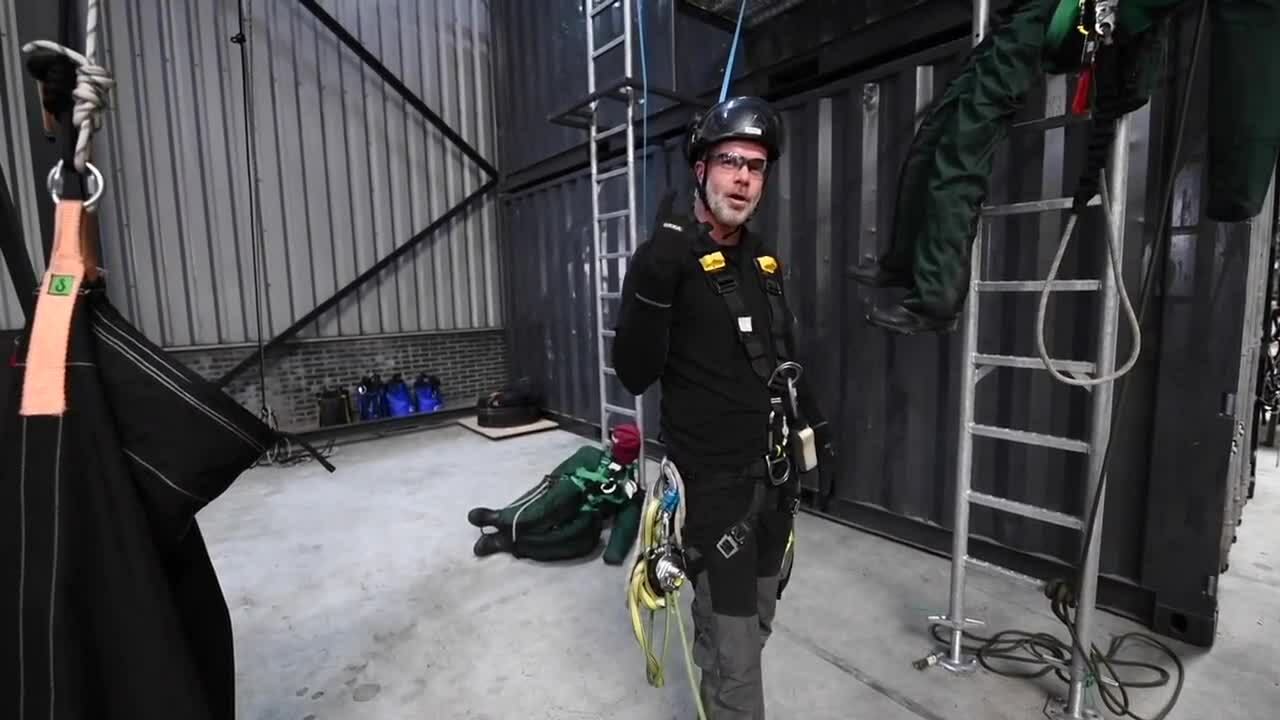
First, Rolf shows us how to evacuate a wind turbine. Usually, there is only one way up in a wind turbine, but the Working Conditions Act makes it compulsory to have a second way down safely. The wind turbine has a particular descent or evacuation device for this purpose. It lowers you down at a controlled speed. Rolf shows you how it works when you want to come down from the wind turbine as quickly as possible.

He describes how the person first lowers himself in a controlled manner. Then, when he is entirely free of the hatch, he lets go of the rope and the device does the rest of the work of lowering him down gently and safely. The device thus makes the descent much easier, but it is vital that it is used correctly!

Rescue from a wind turbine
Then Rolf shows us a demonstration of a rescue inside a wind turbine. This is of vital importance, because you depend on each other when a rescue turns out to be necessary. That is why it is so important to practise this a lot and to keep your skills up-to-date. A brief summary of an example of a wind turbine rescue is as follows: 

When there is an incident with your colleague in the wind turbine, you check the victim's consciousness. You then follow the emergency procedure of the client or your employer. You indicate where you are and what is going on with your colleague. For instance, you say: 'I have an unconscious victim here in a harness, at the height of 20 to 30 metres'. You indicate that you are alone and are going to perform a rescue. Then you climb up to your colleague. You check again that your colleague is conscious and then hang up the rescue equipment. You then pull your colleague up a bit with the rescue equipment so that you can unhook his fall arrest device. You then have control over the victim. You then connect to the rescue device and remove your own fall protection. Finally, you switch on the device and supervise your own descent and that of the victim so that you both get down safely.

At the bottom, it is still essential to apply victim aftercare and hand the person over to the professional emergency services.

We would be happy to take care of your next safety training
Is it time to refresh your skills, or are you looking for a party that can help you get your first training and the necessary certifications? Feel free to contact us. We will be happy to tell you more about the possibilities!

Learn more about Rolf
We recently interviewed our enthusiastic trainer. Read the interview with trainer Rolf!

More information about DELTA Safety Training
View our training offer. Would you like a no-obligation consultation on a suitable training course? Or are you curious about which certificates are important in your work? Then contact us for a tailor-made training advice without any obligation by filling in the form below.

Contact form

  • This field is for validation purposes and should not be changed.